
Little known outside the region, Ratafia Champenois is a longstanding winegrowers’ tradition. Here is a clear guide to its origins, production method and food pairings.
The essentials
- Ratafia Champenois is a traditional liqueur made from grape must and eau-de-vie from marc or Fine de Champagne, around 17-18°.
- It can be served chilled, as an aperitif or as an after-dinner drink, and goes well with foie gras or desserts.
- Champagne Philippe Fourrier makes two ratafias, to discover in our range Ratafias & Coteaux Champenois.
What is ratafia champenois?
Ratafia champenois is a typical liqueur from Champagne, obtained by mixing fresh, unfermented grape must with an eau-de-vie made from marc or Fine de Champagne. Fortification stops the fermentation of the must, which thus retains all its natural sugar and part of its fresh fruit aromas. The result is a sweet, golden or pink liqueur depending on the grape varieties used, generally between 17 and 18 degrees.
Unlike Champagne, ratafia is not sparkling: it is a liqueur wine, in its own right, which has been part of the heritage of Champagne winegrowers for several centuries.
Where does Ratafia Champenois come from?
The origin of ratafia dates back to an ancient practice of preserving grape must. Before the appearance of modern means of preservation, winegrowers fortified part of their must with eau-de-vie to preserve it beyond the harvest, thus building up a reserve to be enjoyed throughout the year. This tradition has been perpetuated at many estates in the Côte des Bar, where ratafia remains today a distinctive speciality of the Champagne region.
How is Ratafia Champenois made?
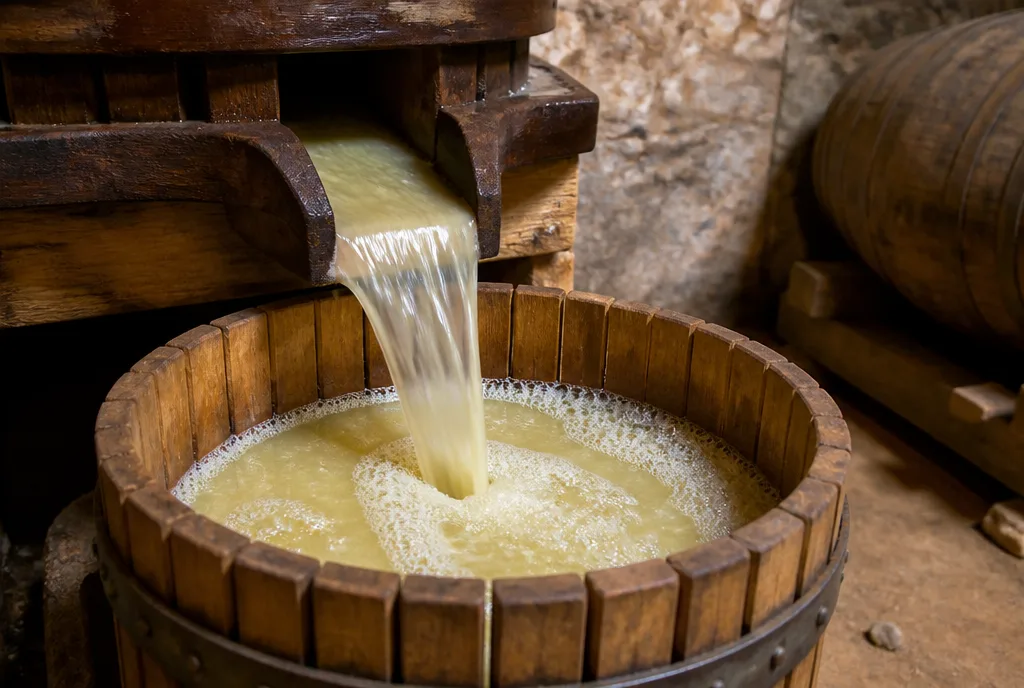
The production method follows a simple but precise principle. The winegrower presses his grapes to obtain a must, which he then mixes with an eau-de-vie of marc or Fine de Champagne, in proportions which vary according to the houses and the desired style. Fortification stops the natural fermentation of the must: the grape sugar is thus preserved, which gives the ratafia its characteristic sweetness. The liqueur is then aged for a few months before being bottled.
How should Ratafia Champenois be served?
Ratafia is served chilled, between 6 and 8 degrees, in a small liqueur glass. It is most often served as an aperitif, to open a meal on a gourmet note, or as an after-dinner drink, at the end of the meal. It may also be served over a few ice cubes, at the end of the afternoon.
What to pair with ratafia champenois?
Its natural sweetness makes it a classic ally of foie gras and terrines, as an aperitif. At the end of a meal, it goes well with a fruit dessert, a tart, or simply a piece of dark chocolate, whose bitterness matches the sweet roundness of the liqueur.
Ratafia at Champagne Philippe Fourrier
A négociant-manipulant in Baroville, Champagne Philippe Fourrier crafts its Ratafias at the estate, with the family know-how passed down in the Côte des Bar. Two versions make up our range Ratafias & Coteaux Champenois: the Ratafia Blanc and the Ratafia Rouge. Also find our Coteaux Champenois and our Fine de la Marne in this same range, or contact us to taste them at the estate.
Frequently asked questions
What is Ratafia Champenois?
It is a traditional Champagne liqueur obtained by mixing unfermented grape must with an eau-de-vie of marc or Fine de Champagne, around 17-18 degrees. Unlike Champagne, it is not a sparkling wine.
How should Ratafia Champenois be served?
Chilled, between 6 and 8 degrees, in a small liqueur glass, as an aperitif or after-dinner drink. It goes well with foie gras, fruit desserts or a square of dark chocolate.
How is ratafia champenois made?
The winemaker mixes fresh grape must with an eau-de-vie of marc or Fine de Champagne. Fortification stops the fermentation of the must, which preserves the natural sugar of the grape and gives the ratafia its characteristic sweetness.